
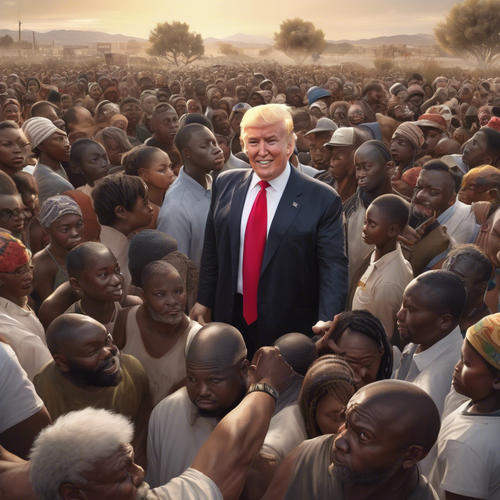
Fact Check: Do Trump’s ‘White Genocide’ Claims to Ramaphosa Hold Up?
In a world rife with misinformation, the rhetoric surrounding racial issues often reaches a fever pitch. Former President Donald Trump’s claim of a “white genocide” occurring in South Africa, which he directed at President Cyril Ramaphosa during a press interaction, has sparked intense debate and scrutiny. But how factual are these incendiary assertions? Let’s explore the context, evidence, and implications of this controversial claim. 🔍
The Origins of the Claim
Trump’s assertion came during a discussion about land expropriation without compensation in South Africa, a contentious issue following the end of apartheid. South Africa’s history is fraught with racial tensions, stemming from decades of institutionalized discrimination against non-white populations. In recent years, the government’s proposals to redistribute land have stoked fears among some white South Africans, leading to claims of impending genocide.
“There’s a big issue going on in South Africa right now, and it’s called the land issue. They’re taking land away from white farmers,” Trump stated, implying a systematic effort to eliminate white people. This statement, however, overlooks critical data. ⚖️
Understanding the Data and Context
To assess the validity of Trump’s claims, one must delve into the statistics regarding violence and crime in South Africa. While it is true that white farmers have experienced violence, the broader picture reveals that crime affects all demographics in the country. According to South African Police Service data, violent crime rates have been consistently high across all racial groups, and the majority of murder victims are, in fact, black South Africans.
- Statistics on Farm Attacks: The prevalence of farm attacks on white farmers has been a focal point of discussion. Data from the Transvaal Agricultural Union indicates that while attacks have occurred, they represent a fraction of the total violent crime incidents in the country. The overall murder rate in South Africa stands at approximately 35 per 100,000 people, with farm murders accounting for around 0.4% of all homicides.
- Land Redistribution Efforts: The South African government has initiated land reform programs aimed at addressing historical injustices, but these efforts are met with resistance and fears of instability. This is often misinterpreted as a direct attack on the white population.
The Historical Perspective
Understanding the term “genocide” is crucial. The United Nations defines genocide as the intent to destroy, in whole or in part, a national, ethnical, racial, or religious group. Critics argue that labeling the current situation in South Africa as genocide is not only misleading but also trivializes the historical atrocities committed during apartheid and other genocides throughout history.
Dr. David Lewis, a South African sociologist, commented, “The narrative of white genocide distracts from the real issues of poverty and inequality that affect millions of South Africans, regardless of race.” 💬
Public Reactions and Political Implications
Trump’s remarks have been met with polarized reactions. Supporters often rally behind the narrative, claiming it highlights a neglected crisis, while critics argue it fuels racial division and perpetuates fear. The political implications are profound, as they tap into broader themes of race and identity politics not only in South Africa but also in the United States and beyond.
The Broader Conversation on Race and Violence
This controversy raises essential questions about race relations, violence, and the narrative surrounding it globally. As communities grapple with their histories and present realities, it is vital to approach these discussions with nuance and an awareness of historical context.
In conclusion, while Trump’s claims regarding “white genocide” in South Africa have ignited fervent debate, a closer examination reveals a more complex reality. It is essential to rely on verified data and context to foster constructive dialogue around these sensitive issues, rather than succumbing to sensationalism. Racial tensions are deep-seated, but they require careful navigation rather than oversimplification. 🕊️