
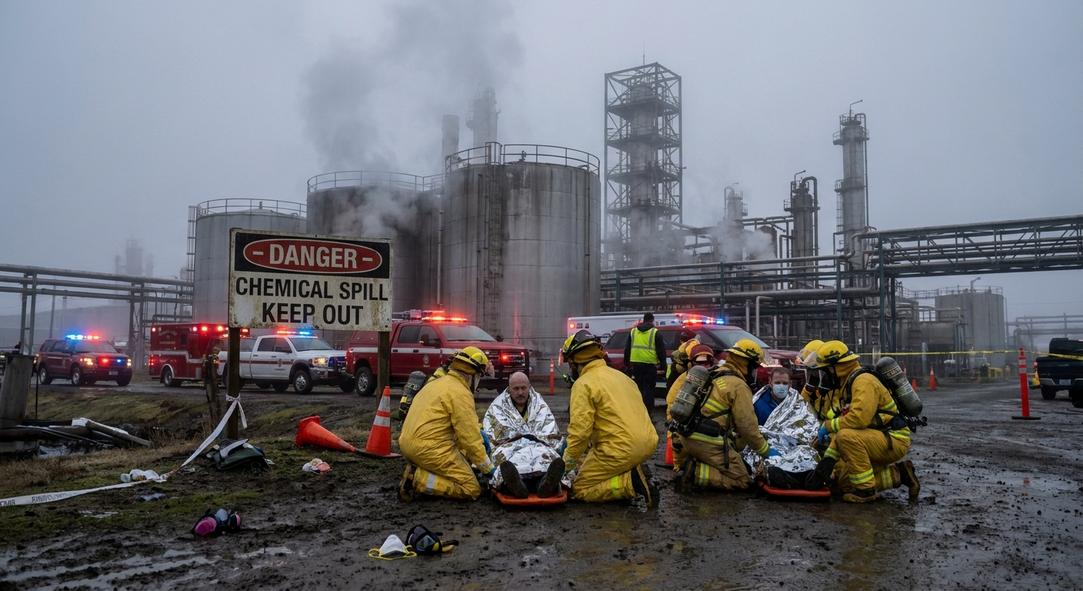
Tragedy in Washington State: Chemical Accidents in Modern Industry ⛏️⚠️
On a crisp autumn morning in Washington state, when whispers of a yet another promising day fluttered through the air, an uninvited specter of tragedy descended. A chemical accident occurred, marking its territory with the permanence of cold steel on tender flesh, in an industrial setting ostensibly designed to champion progress. ⚗️ The result: eleven lives lost, eleven families shattered, and a community left to grapple with the unspeakable irony of civilization’s dual promises – advancement and peril.
The Double-Edged Sword of Progress
Industrial advancements are hailed as the pinnacles of human ingenuity; yet, like a boomerang, they seem to return, threatening the very hands that craft them. The dichotomy here is sharper than a knife: on one side, the shining blade of economic opportunity, and on the other, the raw edge of human vulnerability. It is a paradox as old as the tools of man, lending itself to thunderous applause and shattering wails alike.
Washington state’s chemical incident serves as a somber reminder of the delicate balance industries must maintain. According to the U.S. Occupational Safety and Health Administration, chemical exposures are responsible for over 450,000 illnesses and injuries annually. In the fog of mechanized life, this statistic stands out as a lighthouse casting shadows of doubt over promised safety.
Unraveling the Ironies of Safety Protocols
Safety protocols, crafted in towering boardrooms and rolled out in sprawling factories, promise a fortress of protection. Yet, much like castle moats in the face of an aerial onslaught, these measures often prove inadequate in shielding workers from unforeseen disasters. Are they as effective as we hope, or merely illusions sewn into the fabric of industrial mythology? 🤔
- Complex Procedures: With each incident, corporations add layers to safety protocols, hoping complexity may stifle chaos.
- Automation Dependency: Trust in automation sometimes trumps human vigilance, leading to an awkward dance between man and machine.
- Proactive vs. Reactionary Policies: Many policies are crafted in the aftermath of tragedy rather than before, akin to erecting flood barriers after a torrent.
These factors illustrate a troubling choreography, where each misstep draws attention not only to procedural gaps but to the inherent irony of protection that fails to protect.
The Human Element
At the heart of such tragedies lies the unassuming worker – the unsung, everyday hero who stands as a bulwark against economic stagnation. Like gears in a grand machine, they turn tirelessly, often overlooked until their absence halts the entire operation. A poignant question arises: Do we value them for their labor or their humanity? 🏭
One survivor of a previous chemical accident, speaking on conditions of anonymity, shared: “Every day, we come with hope – hope that today, the sun will set as it rose, with everyone accounted for.” This hope, as fragile as paper fluttering in the wind, must be shielded vigorously by those with the power to effect change. The collective responsibility cannot be understated.
In the Wake of Tragedy: Industry’s Path Forward
So what now, in the aftermath of yet another tragedy that thickens the annals of industrial lore with stories better left untold? One answer lies in a renewed commitment to innovation not just for profit but for safety. Advances in sensor technology, for instance, could act as early-warning systems, much like canaries in coal mines once did – a simile as old as industry itself, harkening back to a less mechanized, yet similarly perilous past.
- Enhanced Training: Comprehensive, engaging training programs that transcend checklists and engage the mind with the realities of risk.
- Robust Safety Cultures: Fostering environments where safety is not just a priority but a core value, embedded into the ethos of operation.
- Responsive Regulations: Policies that evolve with the pace of industry, not in its wake.
Where Do We Stand Now?
The events in Washington serve as an indelible reminder that the pursuit of industrial greatness must not eclipse the sanctity of human life. In the complex dance of progress, perhaps the question isn’t how many can be employed in the process, but how many return home unscathed each day. In the end, even amidst the clatter of machinery, the whisper of safety must never be silenced. 🌍✨