
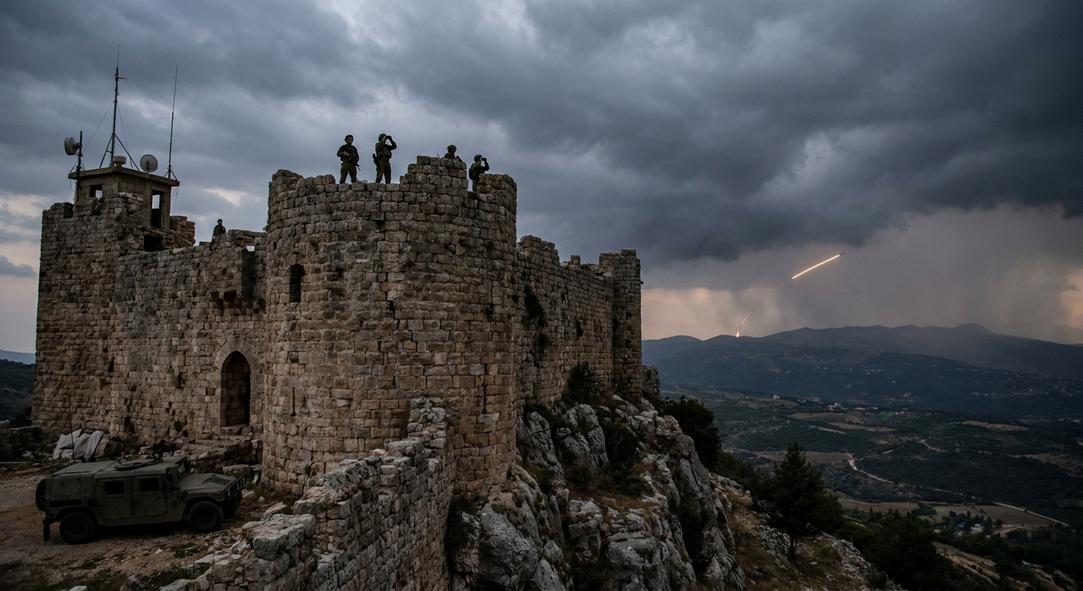
Israel’s Bold Move: Seizing History Amidst Conflict 🏰🇮🇱
In an age where art imitates life, and vice versa, perhaps nothing is more ironic than an army seizing a castle. Israel’s unexpected military maneuver, claiming an ancient stone sentinel on the Lebanese landscape, casts a long shadow over an already tumultuous region. What joins an old knight’s keep and modern warfare but the sharp irony of relics and rockets colliding in the shadow of antiquity? ⚔️
The Grit of History Versus the Sands of Time
The fortress, standing as still and certain as the immutable mountains from which it rises, finds itself an accidental protagonist in a power struggle seemingly writ in biblical prose. A structure conceived to repel horsemen now watches missiles arc across the horizon. If stones could speak, what tales of barracks and scribe rooms past might they recount? Perhaps they ponder the antithesis of past and present, where the old stone defends against new threats it scarcely comprehends.
But as history shows, the Middle East is a region where the past is never far behind. The choice of target raises poignant questions: is there value in possessing a symbol, or does the presence of soldiers atop its parapets render history a mere pawn? 📜🕊️
Modern Challenges in an Ancient Setting
As Israel extends its ground operations, what remains unstated yet unmistakable is a shift from defense to an assertive grip over territory—territory carved with as much history as geopolitical tension. Here lies a complex tapestry of irony and symbolic power moves, where borders are both real and ideological.
The current conflict, fraught with layers of dissonance, contrasts visions of peace with echoes of iron shields and siege towers. The irony? As ages pass, weaponry evolves, politics shift, yet the acrid sting of conflict remains unchanged—like an old theatrical backdrop that history relentlessly dresses with new actors, yet unchanged lines.
Questions Written in Stone and Sky
Why this castle, why now, one might ask? In an age of cyber warfare and drones, perhaps the capture of such a relic is a gesture as quaint and significant as a king’s signature on vellum. Does it assert dominance, validate a point—or spark a narrative as ephemeral yet vivid as a sunset reflected in a dusty glass of antiquity?
This act, set against a backdrop of escalating regional tensions, compels the international community to ponder the real endgame. Are these actions merely the shadow plays of more profound diplomatic rifts that we scarcely grasp? Or is it just one more simile in the complex poem of the Middle East, a battlefield where history is as fluid as the shifting culverts beneath its sunbaked stones?
🤔 As we grapple with these questions, let us remember: a seized castle is not just stone and mortar conquered; it is the wrested sovereignty of future dialogues. It reminds us that in the shuffle of power, sometimes it is the static that speaks the loudest.